Event-Driven Architecture
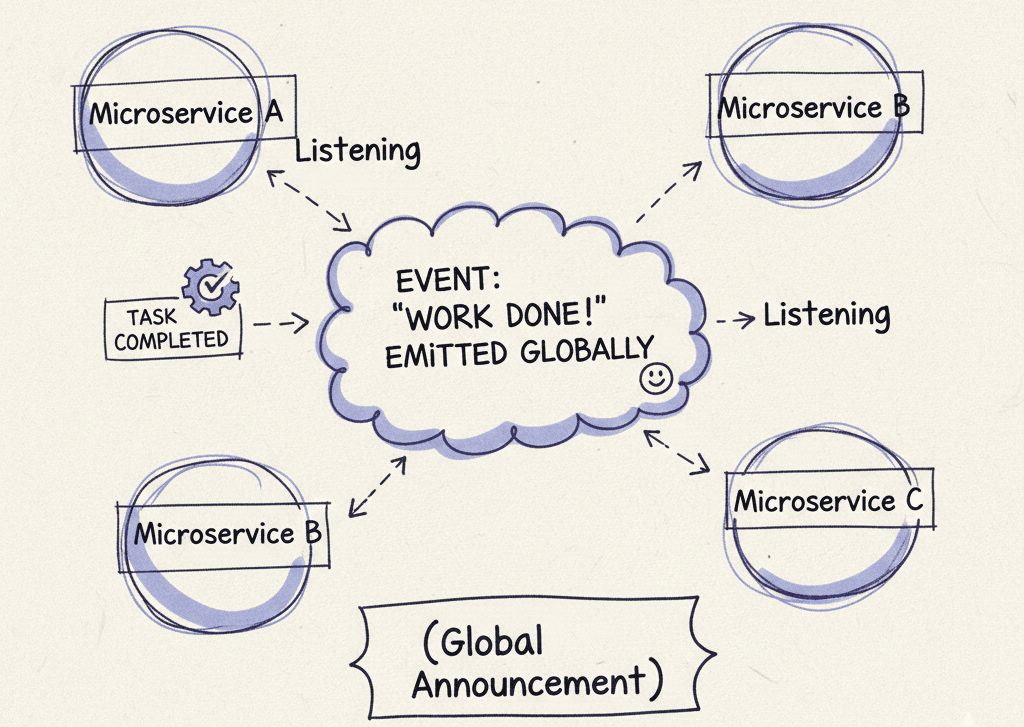
Event-Driven Architecture is a way of designing software architecture in which microservices (think it as independent workers that only care about its work only), so when a microservice is given a task, it completes it and emits an event globally to announce its work is “done”.
Event-Driven Architecture
Little Personal Story
This was all started when I was searching ideas about hackathon that is going to happen in my city. It is at national level hackathon, and I found one which was this → Session. But problem was in our team we had two MERN/Node dev, and two Django dev and one AI/ML dev. I was confused: is there any solution / backend framework that is language independent (obviously we can make use of API calls to work with others). I was searching and thinking: is there a way to write backend with two separate frameworks, as my project has backend in two parts. One is (Node) real-time WebSocket server and other is REST like DB, auth and everything with Django. That is when I found motia.dev, and since I also used to watch Chai aur Code (YT) videos, he covers about it too. Well, we’ll go deeper into that later, but let’s just understand primitive working, or let’s say in which architecture style motia was built upon. It was EDA, but not as opening multiple apps, but an operating system.
What is Event-Driven Architecture
Event Driven Architecture is a way of designing software architecture in which microservices (think it as independent workers that only care about its work only), so when a microservice is given a task, it completes it and emits an event globally to announce its work is “done”.
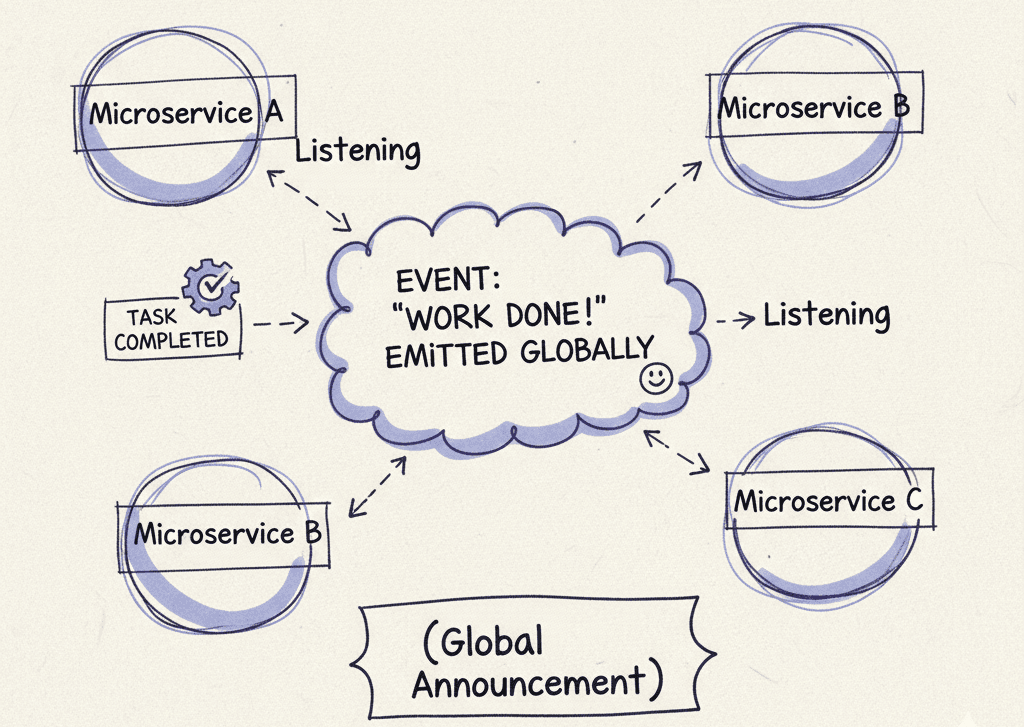
To put it in simpler words: instead of Service A directly calling Service B and waiting for a response, Service A simply emits an Event into the system ("Hey! User #102 just registered!"), and walks away.
Whoever in the system cares about user registrations — like an email notifier service, an analytics service, or a database indexer — reacts to that event independently.
The Three Main Pillars of EDA
Every Event-Driven System relies on three fundamental building blocks:
-
Event Producers (The Announcers): These are services that detect a state change or complete a task, create an event object, and publish it.
-
Event Bus / Broker (The Postal Service): The central channel that receives published events and delivers them to interested subscribers. Popular examples include Apache Kafka, RabbitMQ, Redis Pub/Sub, or custom event routers.
-
Event Consumers (The Responders): Independent services listening to specific event topics. When an event arrives, they process it without affecting the producer.
Here is what an event payload typically looks like:
{
  "eventId": "evt_987654321",
  "eventType": "USER_REGISTERED",
  "timestamp": "2026-02-07T12:00:00Z",
  "payload": {
    "userId": "user_42",
    "email": "dev@example.com",
    "role": "developer"
  }
}
Request-Response vs. Event-Driven: The Mental Model
To really grasp EDA, let's contrast it with traditional REST/gRPC API communication.
1. Traditional Request-Response (Synchronous & Coupled)
Imagine ordering food at a restaurant counter, but the cashier holds your hand and walks with you into the kitchen, waits for the chef to cook your meal, hands it to you, and only then takes the next customer's order.
If the kitchen is slow or crashes, the entire line stops.
[Client] ---> (HTTP POST /users) ---> [Auth Service] ---> (HTTP POST) ---> [Email Service]
                                             |
                                             v (HTTP POST)
                                     [Analytics Service]
If Email Service goes down, the entire user registration request fails!
2. Event-Driven (Asynchronous & Decoupled)
Now imagine ordering at a coffee shop: you order, get a receipt with a ticket number (Event), and step aside. The barista processes orders as they come. When your ticket number is called, you pick up your coffee.
[Auth Service] ---> Emits "USER_REGISTERED" ---> [ Event Bus ]
                                                      |
                 +------------------------------------+------------------------------------+
                 |                                    |                                    |
                 v                                    v                                    v
       [Email Service]                       [Analytics Service]                  [DB Logging Service]
If the Email Service goes down temporarily, the event stays safe in the Event Bus queue and gets processed as soon as the service recovers — without blocking the user!
How EDA Solved Our Hackathon Dilemma (Session + Motia.dev)
Remember the hackathon problem I mentioned earlier? We had Node.js devs, Django devs, and an AI/ML dev — all working on the same project: Session.
With Event-Driven Architecture, language barriers disappear:
- Node.js (Real-time WebSocket Server): Handles live collaborative code editing and emits events like
CODE_CHANGEDorCURSOR_MOVED. - Django (Auth & DB Service): Listens for
USER_JOINEDorSESSION_SAVEDevents to manage persistence and authentication. - Python AI/ML Service: Listens for
CODE_CHANGEDevents, runs background code suggestions, and emitsAI_SUGGESTION_READY.
None of these services need to know how the others are built internally. They only need to know which events to listen to and what event schema to produce.
Why Choose Event-Driven Architecture?
Here are the biggest advantages I've learned:
- Language Independence (Polyglot Friendly): Write your auth in Django, WebSocket in Node, and ML in Python — events bridge them effortlessly.
- Extreme Scalability: You can scale consumer microservices independently based on event traffic load.
- Fault Tolerance: If a consumer service crashes, events wait in the queue without crashing the producer or breaking the UI.
- Extensibility: Want to add a new feature (like Slack notifications on user signup)? Just attach a new consumer service listening to the existing event — zero changes required in existing services!
The Trade-Offs (What to Watch Out For)
No architecture is a silver bullet. When building with EDA, keep these challenges in mind:
- Eventual Consistency: Data isn't updated across all services in the exact same millisecond. Your UI needs to handle slight latency smoothly.
- Debugging & Tracing Complexity: Tracking down bugs across asynchronous event streams requires distributed tracing tools (like OpenTelemetry or correlation IDs).
- Duplicate Events: Networks can retry sending events. Always design your consumers to be idempotent (handling the same event twice safely).
Wrapping Up
Discovering Event-Driven Architecture while building Session completely shifted how I think about backend systems. It transformed a potential hackathon team conflict into a clean, modular, and language-agnostic architecture.
Whether you're building a real-time collaborative app or connecting microservices across Python and JavaScript, EDA gives you the freedom to build independent services that communicate seamlessly.
Have you built anything using EDA or frameworks like Motia? Let me know your thoughts!